
Overview
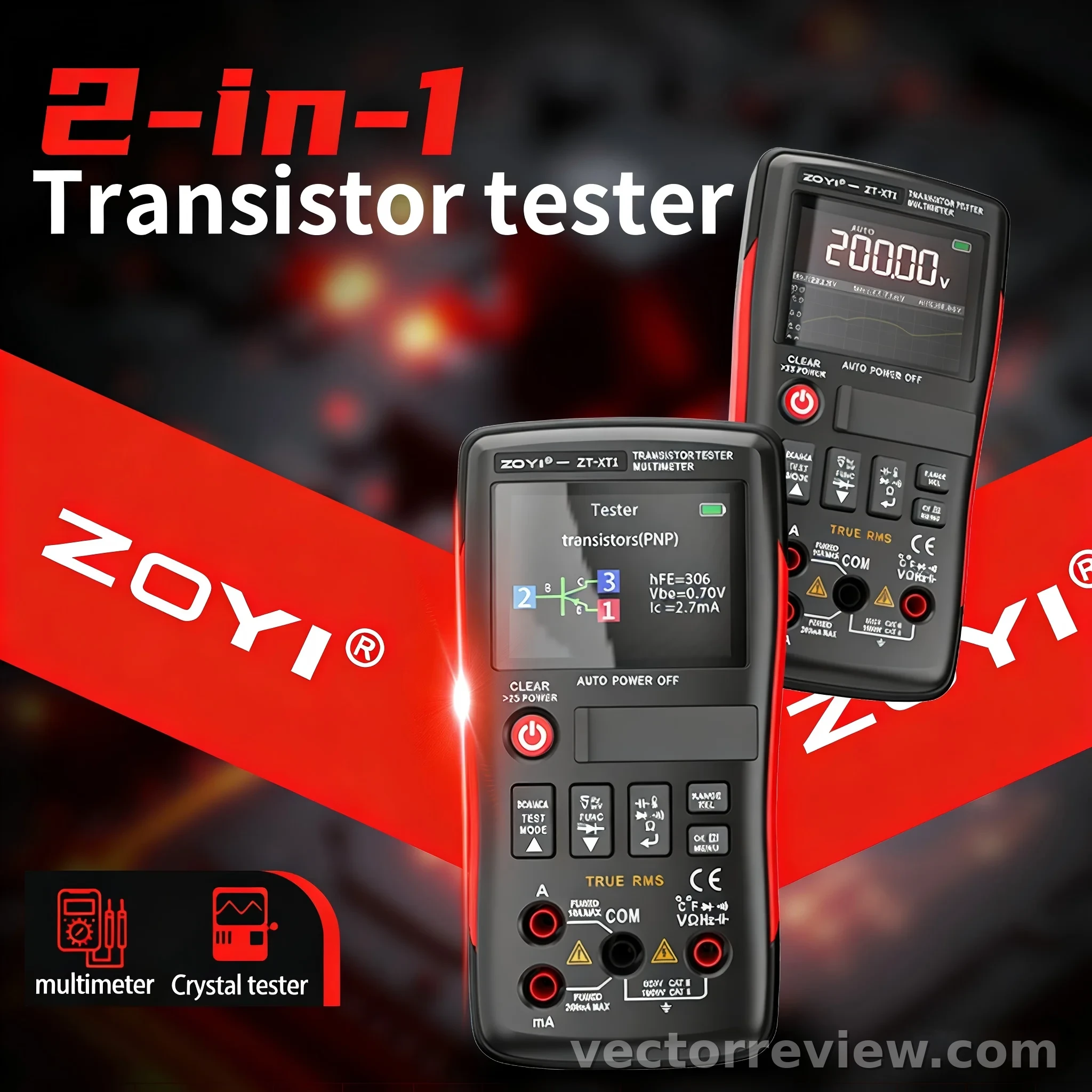
The ZOYI ZT-XT1 is a handheld test instrument that combines a digital multimeter with a component tester. It is designed for electronics professionals, repair technicians, and advanced hobbyists who need to measure circuits and identify components without carrying separate devices. The ZT-XT1 is part of ZOYI's growing lineup of test equipment, which includes oscilloscopes, LCR meters, and thermal multimeters.
What It Offers
The ZT-XT1 integrates two main functions:
Multimeter
- True RMS measurement for accurate AC readings on non-linear signals.
- 25,000-count resolution for precise measurements.
- Voltage: up to 1000V DC / 750V AC.
- Current: up to 10A AC/DC.
- Resistance: up to 250MΩ.
- Capacitance: up to 99.99mF.
- Frequency: up to 1MHz.
- Temperature: supports external DS18B20 and DHT11 sensors.
- Additional features: data hold, REL, auto-ranging, MAX/MIN/AVG recording, diode test, and continuity buzzer.
Component Tester
- Automatic identification of NPN/PNP transistors, MOSFETs, JFETs, IGBTs, diodes, Zener diodes, resistors, capacitors, and inductors.
- Parameter measurement: hFE, Vbe, Vf, Vz, ESR, Rds, capacitance, inductance, and resistance.
- Ranges: resistance 0.01Ω–30MΩ, capacitance 1pF–100mF, inductance 10µH–1000mH, Zener voltage up to 32V.
- Dual test sockets for both SMD and through-hole components.
- Infrared decoding for NEC protocol remote controls.
System and Design
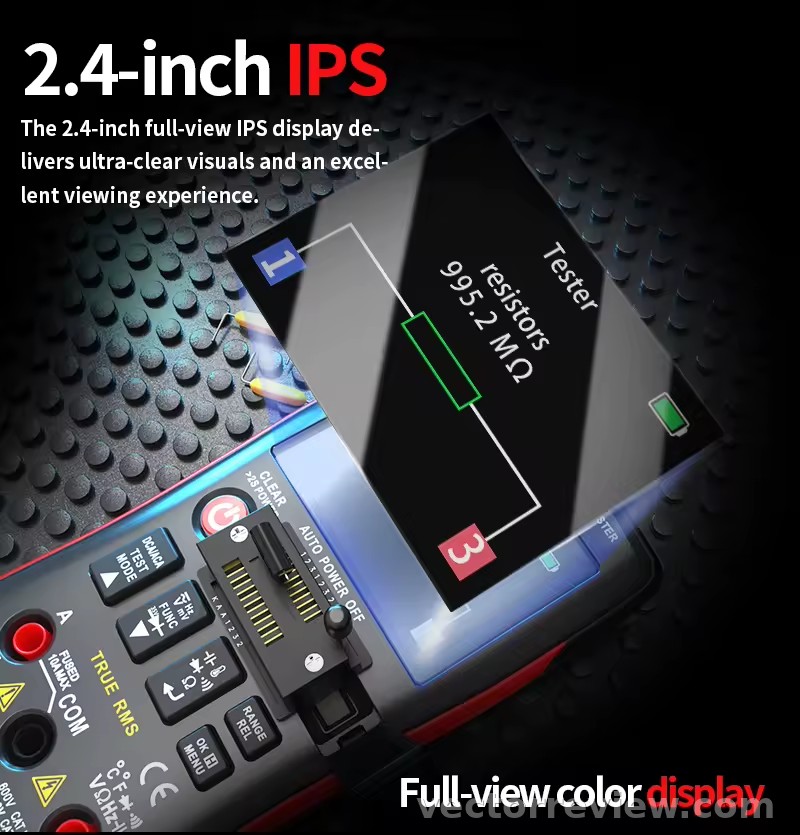
- 2.4-inch TFT color display with a real-time measurement interface.
- Rechargeable 2000mAh lithium battery with USB Type-C charging.
- Firmware upgradeable via USB.
- Compact size: 149 × 76 × 33.5 mm, 191g.
- Adjustable screen brightness and buzzer volume, auto power-off, and factory reset.
Pricing
The ZT-XT1 is priced around $39–$40 in China and can be found for under $40 internationally. In Western markets, it may retail for $65–$70. This places it in the mid-range for combined test instruments, but some users feel it is expensive compared to buying a separate multimeter and component tester.
User Experiences
Feedback from electronics forums and reviews highlights several points:
- Performance: Both the multimeter and component tester functions work adequately, though some users note the lack of low current ranges (250μA and 2.5mA) limits its use for low-power electronics as a primary meter.
- Usability: The rubber button interface is considered less ergonomic than a rotary dial by some users. The auto-ranging and automatic component identification are convenient.
- Build quality: The device feels solid, with an ABS and TPE housing that is impact-resistant and anti-slip.
- Value: Opinions are mixed. Some appreciate the 2-in-1 convenience and the IPS display, while others prefer dedicated instruments like the ZT-225 multimeter and a separate TC1 component tester for similar or lower cost.
- Firmware: The firmware is upgradeable, and the internal design uses an Artery AT32F403A Cortex-M4 MCU for the multimeter and a Nation N32G031 Cortex-M0 for the component tester, which may interest tinkerers.
Pros and Cons
Pros
- 2-in-1 functionality saves bench space and cost.
- True RMS and 25,000-count resolution for accurate measurements.
- Wide component testing capabilities with automatic identification.
- Color display with clear readouts.
- Rechargeable battery and USB-C charging.
- Firmware upgradeable.
Cons
- Missing low current ranges (250μA, 2.5mA) for low-power work.
- Button interface may be less ergonomic than a rotary dial.
- Price considered high by some compared to separate devices.
- No 25mV range (unlike some other ZOYI models).
- Frequency measurement limited to 1MHz.
Summary
The ZOYI ZT-XT1 is a versatile tool that combines a capable True RMS multimeter with a smart component tester. It is well-suited for electronics repair, education, and DIY projects where both functions are needed. However, its lack of low current ranges and button-based interface may deter some users. If you primarily need a multimeter, a dedicated model like the ZT-225 might be more cost-effective. But if you want the convenience of component testing alongside standard measurements, the ZT-XT1 is a solid choice, especially if found under $40.


