
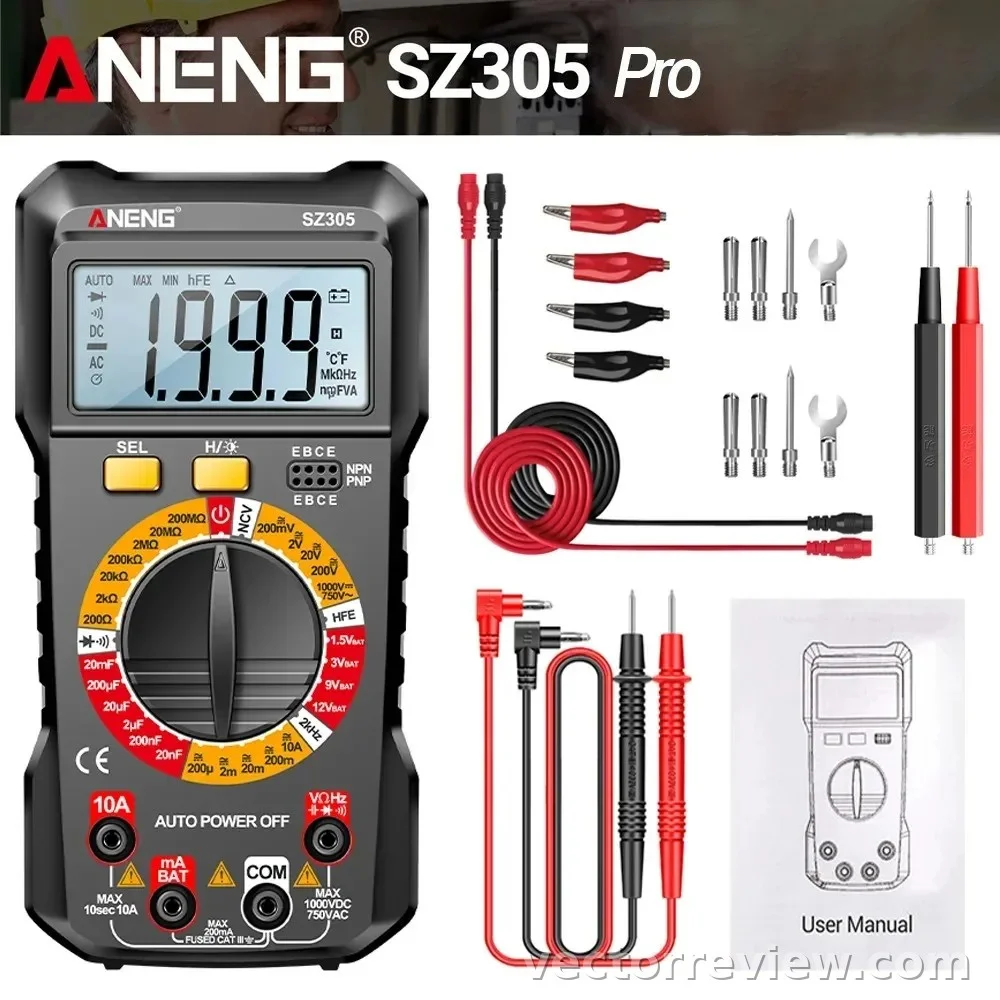
Overview of the ANENG SZ305
The ANENG SZ305 is a budget-friendly digital multimeter aimed at DIY enthusiasts, hobbyists, and professionals who need a basic, portable testing tool. Manufactured by ANENG, a brand known for producing affordable test equipment, the SZ305 typically sells for around $10 to $15, making it one of the most inexpensive multimeters on the market. Despite its low price, it packs a surprisingly wide range of functions, including AC/DC voltage, current, resistance, capacitance, frequency, diode, and continuity testing, plus extras like transistor hFE measurement, non-contact voltage (NCV) detection, and battery testing. In this review, we’ll examine its features, performance, user feedback, and overall value.
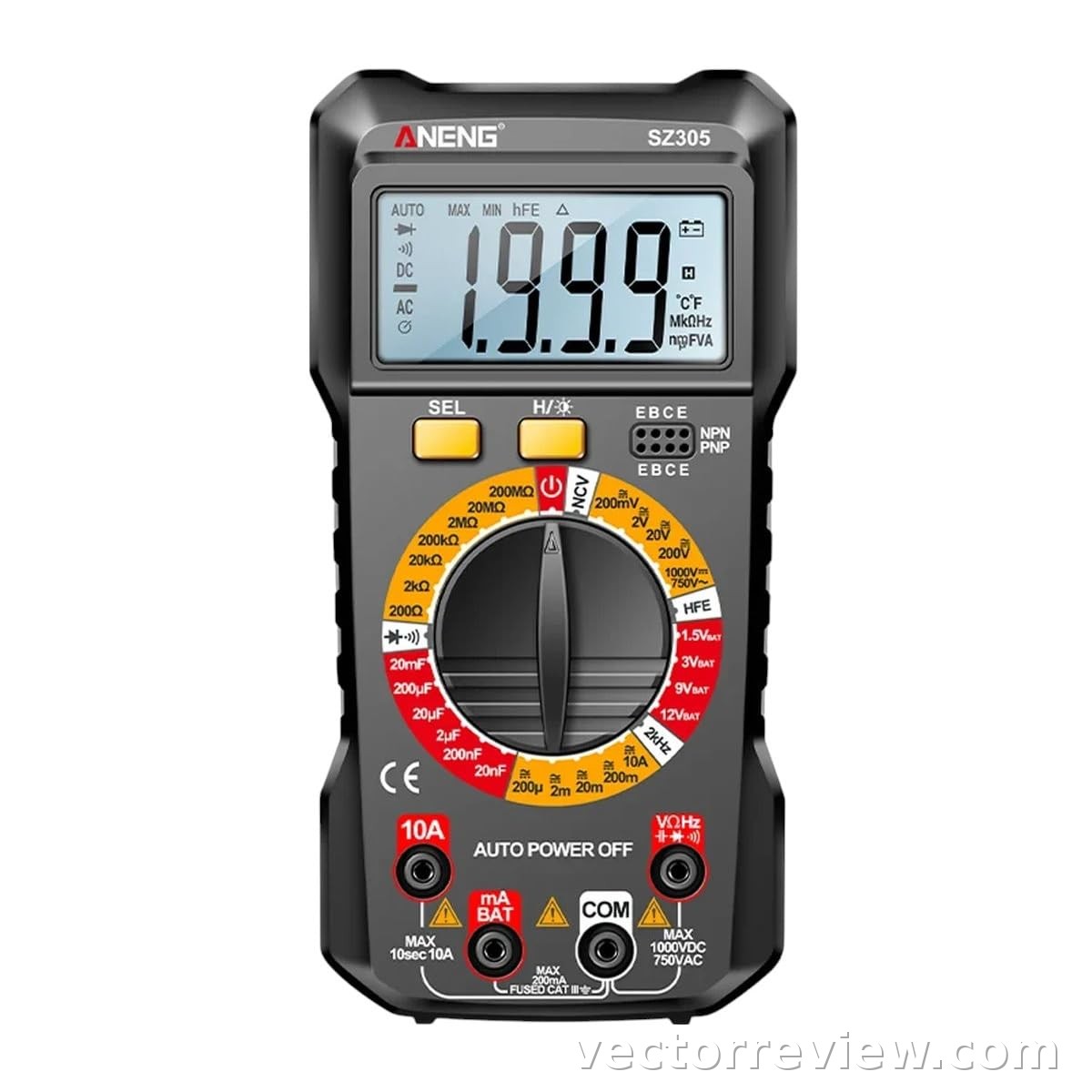
Key Features and Specifications
The SZ305 is a 1,999-count manual-ranging multimeter, meaning it does not auto-select measurement ranges; users must turn the dial to the appropriate setting. It measures AC voltage up to 750V and DC voltage up to 1000V, with a resolution of 0.1mV on the lowest range. Current measurement covers AC and DC from 200µA to 10A. Resistance ranges from 0.1Ω to 200MΩ, and capacitance up to 20mF. Frequency measurement goes up to 2kHz. The meter also includes a diode test, continuity buzzer, and an hFE socket for testing transistors. Non-contact voltage detection allows users to check for live AC wires without direct contact. The battery test mode supports 1.5V, 3V, 9V, and 12V batteries, a handy feature for household use.
The SZ305 is powered by two AAA batteries (not included), which is convenient compared to 9V batteries. It has a backlit 3.0-inch LCD screen, data hold function, and auto power-off to conserve battery life. The device is lightweight at 158g and compact at 188 x 91 x 38 mm, making it easy to carry. It comes with a pair of test leads and an English user manual.
Performance and Accuracy
Accuracy is where the SZ305 shows its budget nature. The specified tolerances are loose: ±1.5% + 5 digits for AC voltage, ±1.5% + 10 digits for DC voltage, ±2.5% + 10 digits for AC current, ±2.0% + 10 digits for DC current, ±5.0% + 10 digits for resistance, and ±6.0% + 20 digits for capacitance. These are not precision-grade specifications, and the meter lacks True-RMS, meaning AC measurements assume a pure sine wave and may be inaccurate with distorted waveforms.
In real-world testing, the SZ305 performs adequately for basic checks. For example, against a 12.00V reference, it read 11.92V; at 100.0V, it showed 99.3V. These readings are within its stated tolerance and are fine for confirming whether a battery is good or an outlet is live, but they are not suitable for calibration or precise diagnostics. The battery test mode correctly identified a healthy 9V battery and a low AA battery. The continuity buzzer responds quickly, and the transistor test socket works as expected.
One notable feature is the backlit display, which users find helpful in low-light conditions. However, the 1,999-count resolution means the display shows fewer digits than higher-end meters, limiting precision.
User Experiences and Feedback
User reviews of the ANENG SZ305 are generally positive, especially considering its low price. Many users praise its value for money, noting that it offers a wide range of functions typically found on more expensive meters. The backlit display and NCV detection are frequently mentioned as useful additions. The battery test mode and the use of AAA batteries (instead of a 9V) are also appreciated.
However, some users report minor issues. A few mention that the included test leads have plugs that are slightly too large for the input jacks, requiring force to connect. Others note that the packaging could be better to protect the meter during shipping, though most units arrive intact. The manual range selection is seen as a drawback by some, who prefer auto-ranging for convenience. Additionally, the accuracy limitations mean it’s not suitable for professional precision work.
On forums like EEVblog, ANENG as a brand receives mixed feedback. Some users report durability issues with certain models, such as the display glass falling off, but this seems more common with other ANENG models rather than the SZ305 specifically. Overall, the SZ305 is viewed as a decent entry-level tool for non-critical tasks.
Pricing and Availability
The ANENG SZ305 is widely available on online marketplaces such as AliExpress, Amazon, and eBay, typically priced between $10 and $15. It often ships from China, so delivery times can vary. Some sellers offer bundles with additional accessories like alligator clips or spare leads. Given its feature set, the price is extremely competitive, but buyers should be aware that customer service and warranty support may be limited compared to established brands.
Pros and Cons
Pros: - Extremely affordable - Wide range of functions for the price - Backlit display for low-light use - Non-contact voltage detection enhances safety - Battery test mode for common household batteries - Lightweight and portable - Uses two AAA batteries (easy to find)
Cons: - Manual ranging only (no auto-range) - Basic accuracy, not True-RMS - 1,999-count resolution limits precision - Test leads may fit too tightly - Packaging could be more robust - Not suitable for professional or high-precision work
Conclusion
The ANENG SZ305 is a remarkable value for anyone needing a basic multimeter for occasional use around the home, in the car, or for simple electronics projects. It covers the essential measurements and adds handy extras like NCV and battery testing. However, its accuracy and resolution are limited, so it’s not a tool for professionals or those requiring precise readings. If you understand its limitations and need an inexpensive, functional meter for basic troubleshooting, the SZ305 is a solid choice. Just don’t expect it to replace a high-end instrument.


