
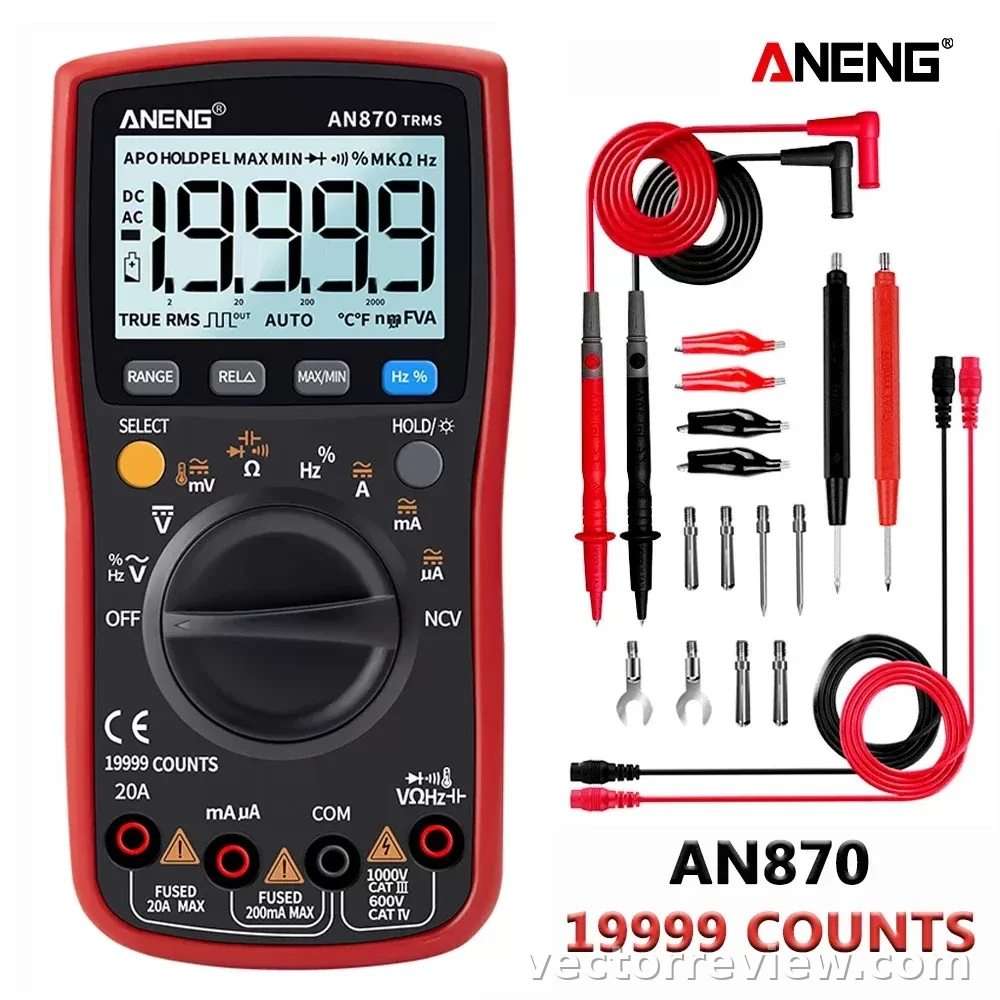
The Aneng AN870 is a budget digital multimeter that has gained a following among electronics enthusiasts for offering high-end specs at a very low price. Priced between $20 and $30, it competes with meters costing several times more. This review examines its features, accuracy, build quality, safety considerations, and what users say.
What Is the Aneng AN870?
The AN870 is a handheld autoranging digital multimeter with a 19,999-count display, True-RMS measurement, and a wide range of functions. It is sold under several brand names, including Zotek ZT219 and Richmeters RM219, but the meter itself is identical across brands. Prices vary from about $17 to $52 depending on the seller and included accessories.
Aneng is a Chinese brand known for producing affordable test equipment that often exceeds expectations on paper. The AN870 is one of their more advanced models, aimed at hobbyists, students, and professionals on a tight budget.
Key Features and Specifications
The AN870 packs an impressive feature set for its price. Here are the main specifications:
| Feature | Specification |
|---|---|
| Display | 19,999 counts, backlit |
| True-RMS | Yes |
| DC Voltage | 0.05% accuracy, up to 1000V |
| AC Voltage | Up to 750V |
| DC/AC Current | Up to 20A |
| Resistance | Up to 199.99 MΩ |
| Capacitance | Up to 200 mF |
| Frequency | Up to 9.999 MHz |
| Temperature | -20°C to 1000°C |
| Update Rate | 3 readings per second |
| Power | 2 × AA batteries |
| Dimensions | 180 × 90 × 45 mm |
| Weight | ~320–368 g |
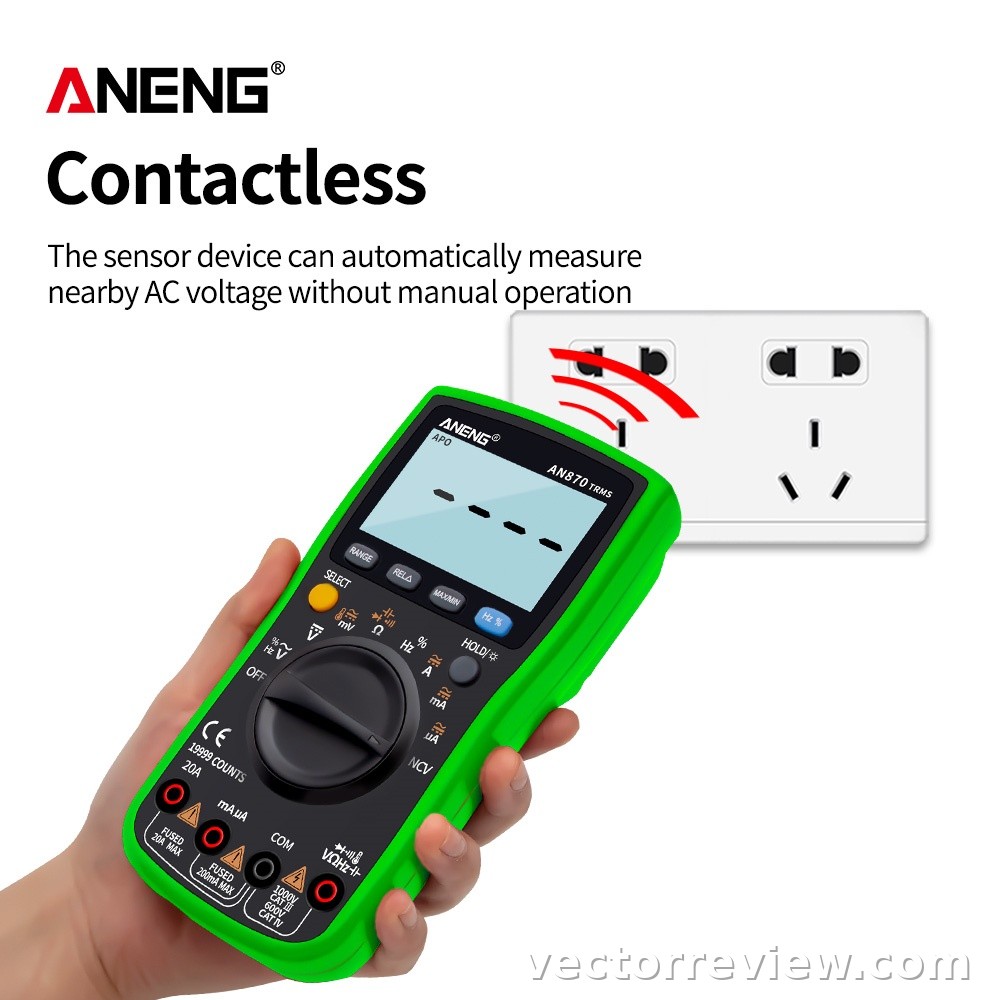
Additional functions include continuity, diode test, NCV (non-contact voltage detection), relative measurement, min/max hold, and duty cycle. The meter also has a separate mA and A input socket, which helps prevent accidental fuse blows.
Accuracy and Performance
Independent tests have shown that the AN870's DC voltage accuracy is surprisingly good. On a calibrated 10.0000V reference, it read 9.998V, and at 100.00V it read 99.97V—well within its ±(0.05%+3) specification. This level of accuracy is rare in this price range.
The True-RMS capability also performs well. On a distorted waveform from a dimmer, it measured 120.9V where a reference showed 121.4V, an error of about 0.4%. This indicates a genuine True-RMS front end, not just a marketing claim.
Capacitance measurement is also accurate: a 1000µF electrolytic capacitor read 988µF, within tolerance. Frequency and duty cycle functions work as expected, though the frequency counter requires a zero-crossing signal.
Build Quality and Design
The AN870 feels sturdy in hand, with a flexible plastic jacket that provides some drop protection. The jacket has a thin plastic stand that is somewhat flimsy, and the probe holders on the back are not very practical.
The rotary switch is acceptable but can be difficult to turn with one hand when the meter is standing. The display is large and easy to read, with a backlight that has a slight hotspot at the minus sign but is otherwise even.
The included test leads are of low quality—users often replace them with better silicone leads. The DIY probe set is also basic, with some reports of missing threads on banana plugs. The thermocouple probe is useful for penetrating measurements but not ideal for surface temperatures.
Safety and Protection
The AN870 has a CAT III 1000V rating printed on its case, but this is not independently certified. Internally, it has only a single PTC and a pair of clamping transistors for input protection, which is minimal. The fuses are decent-sized ceramic types (6x30mm for the 200mA range, 20A for the high-current range).
Experts strongly advise against using this meter for high-energy mains work. It is best suited for bench electronics, low-voltage projects, and hobby use. For live electrical work, a properly certified meter from a reputable brand is recommended.
What Users Say
User feedback on forums like EEVblog and BudgetLightForum is generally positive. Many appreciate the high resolution, accuracy, and feature set for the price. The separate mA and A sockets are praised for reducing the risk of blowing fuses.
Common complaints include the poor quality of included probes, the flimsy stand, and the misleading CAT rating. Some users also note that the rotary switch can be stiff. Overall, most users find it an excellent value for hobby and bench work.
Pricing and Where to Buy
The AN870 is available from various online retailers, including Banggood, AliExpress, and Amazon. Prices range from about $17 to $30, depending on the seller and included accessories. Some packages include a full set of test leads, a thermocouple, and a pouch, while cheaper options may only include basic probes.
It's worth checking the included accessories before buying, as the meter itself is the same across all sellers.
Pros and Cons
Pros: - Excellent accuracy for the price - True-RMS measurement - High 19,999-count resolution - Comprehensive range of functions - Separate mA and A inputs - Large, clear display with backlight - Good battery life with 2 × AA batteries
Cons: - CAT rating not independently certified - Poor input protection for high-voltage use - Included test leads are low quality - Flimsy stand - Rotary switch can be stiff - Not suitable for professional high-energy work
Final Verdict
The Aneng AN870 is a remarkable budget multimeter that offers features and accuracy typically found in much more expensive models. For hobbyists, students, and bench work, it provides outstanding value. However, its safety limitations mean it should not be used for mains or high-voltage applications where certified protection is essential.
If you need a reliable meter for low-voltage electronics and don't want to spend a lot, the AN870 is a solid choice. Just be prepared to replace the included probes and use it within its safe operating limits.


